Why Creators Need a CRM to Manage Brand Deals
Spreadsheets lose deals. Here's why a dedicated sponsorship workflow matters — and what to look for in a creator CRM.
The spreadsheet ceiling
Every creator's brand deal "system" starts the same way: a Google Sheet with columns for brand name, contact email, status, and maybe a rate. It works fine for your first few deals. By the time you're juggling 5–10 active conversations, the cracks show.
Pitches get lost in your inbox. You forget who needs a follow-up. You can't remember what you quoted a brand three months ago. A deal goes cold because you didn't reply within 48 hours — not because the brand wasn't interested, but because their email got buried under 30 others.
This isn't a discipline problem. It's a systems problem. And the cost is real: every deal that dies from a missed follow-up is money you earned with your content but lost to admin chaos.
What actually falls through the cracks
Follow-ups (where most deals actually close)
The data is clear: the majority of positive brand responses come on the second or third touch, not the first. Your initial pitch opens the door; the follow-up is where deals happen. But without a system tracking who needs a nudge and when, follow-ups become "I'll do it tomorrow" tasks that never happen.
The creators who close consistently aren't better writers — they're better at following up. The difference between earning $2K/month and $8K/month from sponsorships is often just the discipline (or automation) of that second email.
Rate consistency
Without a record of what you've charged in the past, you end up in one of two traps:
- Underquoting: You forget what the market pays and default to whatever feels "safe" — usually 30–50% below what you should charge
- Inconsistency: You quote Brand A $1,500 and Brand B $800 for the same deliverable because you didn't remember your own pricing
A system that shows your rate history and market benchmarks means every quote is informed, not improvised.
Pipeline visibility
You can't grow what you can't see. Basic questions that a spreadsheet makes surprisingly hard to answer:
- How many deals are in active negotiation right now?
- What's your pitch-to-close rate?
- Which niches/platforms convert best for you?
- What's your average deal value over time — is it going up?
- How much revenue is in your pipeline for next month?
These aren't vanity metrics. They're the data that tells you whether your sponsorship business is growing or plateauing — and what to fix.
Contact decay
Brand partnership managers change roles constantly. The person you emailed 3 months ago may have moved to a different company. If your system doesn't help you track the relationship (not just the email address), you're starting from scratch every time someone changes their LinkedIn title.
What a creator CRM should actually do
A CRM purpose-built for sponsorships isn't a generic sales tool (Salesforce, HubSpot) with a creator skin. Those tools are built for B2B sales teams with 50-stage pipelines and enterprise pricing. A creator CRM should:
Track the full deal lifecycle
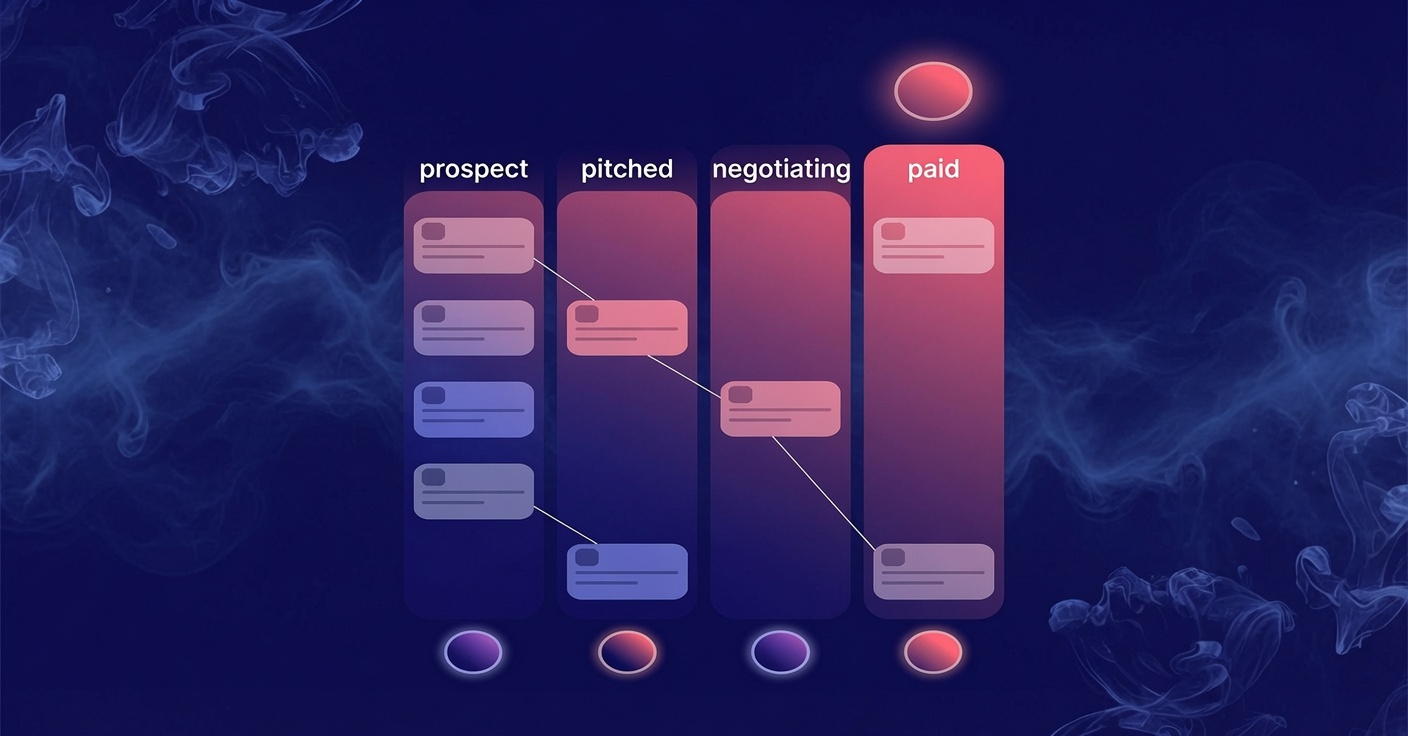
From "I found this brand" to "payment received" — every stage in one view. Not scattered across email, DMs, a spreadsheet, and your Notes app. One pipeline that shows you what needs attention right now.
Automate follow-up timing
The single highest-ROI feature in any creator tool is automated follow-ups. Not spam — smart, timed nudges that fire when a brand hasn't replied in X days, and pause automatically when they do. This alone recovers deals that would otherwise die in silence.
Provide rate intelligence
Knowing what others charge removes the guesswork from every negotiation. A good tool shows you what creators with similar audiences charge for similar deliverables — so you quote with confidence instead of anxiety.
Help you find brands to pitch
A directory of brands actively sponsoring creators in your niche, with the right contact person, saves hours of research per week. Instead of Googling "brands that sponsor fitness creators" and hoping for the best, you search a database filtered by niche, budget range, and recent activity.
Draft pitches that don't sound generic
AI pitch generation that knows your voice, your stats, and the brand's context produces a strong first draft in seconds. You edit and send instead of staring at a blank email for 45 minutes.
The real cost of "free" tools
The DIY stack (Notion + Gmail + ChatGPT + Google Sheets) costs $0 in subscription fees. But it's not free:
- Time cost: 5–10 hours/week on admin that a dedicated tool automates
- Missed deals: Every follow-up you forgot to send is potential revenue lost
- Underpricing: Without rate data, you're guessing — and guessing almost always means leaving money on the table
- Context switching: Jumping between 4–5 tools for one workflow kills your creative flow
If your time creating content is worth more than $10/hour (it is), then a tool that saves you 5+ hours/week of admin is the obvious trade.
When to upgrade from a spreadsheet
You've outgrown the spreadsheet if any of these are true:
- You're managing more than 3 active brand conversations at once
- You've forgotten to follow up on at least one deal in the past month
- You're not sure if you're charging the right rate
- You spend more than an hour per week on deal admin (tracking, emailing, updating status)
- You've lost a deal because you replied too late
The sooner you systematize your deal flow, the faster your sponsorship revenue compounds. Every month you wait is another month of deals slipping through the cracks.
What to look for when choosing a tool
- Built for creators, not salespeople: Generic CRMs have features you'll never use and lack the ones you need (rate data, pitch templates, content-specific workflows)
- No commission model: Tools that take a percentage of your deals are misaligned with your interests — the more you earn, the more they take
- Flat, predictable pricing: You should know exactly what you're paying each month, regardless of how many deals you close
- Follow-up automation: This is the single highest-value feature. If a tool doesn't automate follow-ups, it's just a fancier spreadsheet
- Rate intelligence: Access to what other creators charge removes guesswork from every negotiation
Key takeaways
- Spreadsheets work for 1–3 deals. Beyond that, deals die from missed follow-ups
- Most brand responses come on touch 2 or 3 — automation here directly equals revenue
- The "free" DIY stack costs you hours of admin and lost deals
- Rate intelligence replaces guesswork with confidence in every negotiation
- Choose tools that charge flat fees, not commissions on your earnings
Ready to land your next brand deal?
AI pitches, rate intelligence, and automated follow-ups — $10/mo, no commission.
Get Started Free